
Nowadays, we expect user interfaces (UIs) to be intuitive, responsive, and tailored to our needs. But how do we really measure whether an interface is like that? It is not just a question of speed and clicks.
We published a recent open-access study in the Journal of Systems & Software that tackles this very question by exploring graphical adaptive menus. It does that with an original approach: it combines traditional usability metrics with real-time brain data, captured by a EEG Bitbrain device.
Adaptive user interfaces (AUIs) are dynamic UIs that change based on the context of use (such as behavior, preferences, or even predicted needs) with the goal of improving the user experience (UX). Adaptive interfaces anticipate what end users need next and present it more prominently or efficiently. But despite their growing use, there’s no clear consensus on which adaptive designs actually help users.
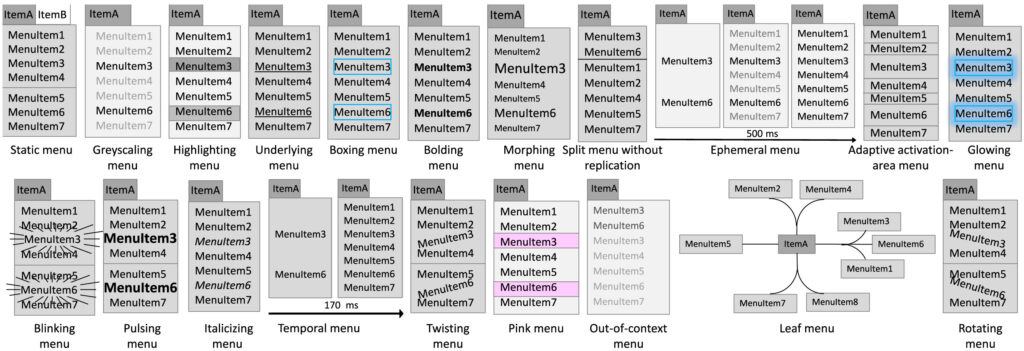
We recruited 40 participants and had them interact with 20 different graphical adaptive menus, such as menus that change colors, highlight predicted actions, or rearrange options, and a baseline static menu. We measured both the task performance (how quickly menu options were selected) and the EEG brain activity (i.e., cognitive load, engagement attraction, and memorization), as well as the user preferences; see more in this paper.
We found that task performance did not always match user preference (menus that were quick were not always preferred, and vice versa) and that different adaptive menus produced distinct brain activity patterns, thereby suggesting that EEG measures can vary widely depending on menu design. We also observed some correlations between neurological biosignals and users’ subjective preferences. This hints that EEG measures could become a valuable UX evaluation tool in the future.
If you are a UX designer, product manager, or developer, this study highlights why thinking beyond traditional usability metrics is important to also include the fascinating world of neuro-UX evaluation.